Happy Pi Day!

I am bone dead tired today so I am cleaning up at home and baking. That is my go-to when my body hurts. I long for the days when I could hike all morning, come home, clean up, and then go about creating and cooking the rest of the day. Alas, the body calls for down time more and more these last few years. It’s how we cope with that loss of energy that leads us to our happy place. And sometimes we just need a nap!

And speaking of a happy place, Happy Pi Day! I didn’t think about this until my family talked about it.

According to Wikipedia, “The number π (spelled out as pi) is a mathematical constant, approximately equal to 3.14159…, that is the ratio of a circle‘s circumference to its diameter. It appears in many formulae across mathematics and physics, and some of these formulae are commonly used for defining π, to avoid relying on the definition of the length of a curve. For thousands of years, mathematicians have attempted to extend their understanding of π, sometimes by computing its value to a high degree of accuracy. Ancient civilizations, including the Egyptians and Babylonians, required fairly accurate approximations of π for practical computations…. The invention of calculus soon led to the calculation of hundreds of digits of π, enough for all practical scientific computations. Nevertheless, in the 20th and 21st centuries, mathematicians and computer scientists have pursued new approaches that, when combined with increasing computational power, extended the decimal representation of π to many trillions of digits.”

And… drum roll please! Here are a bazillion Pi jokes from the Pioneer Woman’s website. She is funny in her nerdy way!

  • What do you call it when someone gets a huge tattoo of pi on their face? An irrational decision.
  • Why should you never argue with pie? Because it always goes on and on!
  • How many bakers does it take to bake a pi? 3.14.
  • Why did pi get its driver’s license revoked? Because it didn’t know when to stop.
  • How many calories are in that slice of chocolate pie? 3.14.
  • What did pi say when someone asked if it could explain what Pi Day was again? “I don’t want to repeat myself.”
  • What’s wrong with the equation ‘pi r squared?’ Pi are round. Cake are square.
  • Why shouldn’t you eat too much pi? You’ll end up with a big circumference.
  • What was Sir Issac Newton’s favorite dessert? Apple pi.
  • If March 14 was really Pi Day, it would never end.
  • How did critics rate Life of Pi? 3.14 stars.
  • What do you get when you take a bovine and divide its circumference by its diameter? A cow pi.
  • What do you get when you divide the circumference of the sun by its diameter? Pi in the sky.
    What do you call a snake who knows math? A pi-thon!
  • How do you celebrate Pi Day at the beach? With a pi-na colada!
  • What did pi say to its partner? You look radian today.
  • Come to the nerd side. We have pi.
  • Who was the roundest knight at Sir Arthur’s table? Sir Cumference because he ate too much pi.
  • 3.14% of sailors are pi-rates.
  • What’s the ideal way to serve pi? A la mode! Anything less is mean.
  • Simple as 3.1415926…
  • What do you get when a bunch of sheep stand in a circle? Shepherd’s pi.
  • What is 1.57? Half a pi.
  • Can you recite pi? Peach, blueberry, pumpkin, pecan
  • Why was the math book sad on Pi Day? It had too many problems.
  • What did the math teacher have for dessert? Banana cream pi!
  • Don’t let advanced math intimidate you!… It’s as easy as pi!
  • What did the triangle say to the circle? You’re pointless.
  • Why couldn’t the angle get his dream apartment? Because his parents wouldn’t cosine.
  • Did you hear about the rancher who had 197 cows in his field? He decided he should round them up, and now he has 200.

https://www.thepioneerwoman.com/holidays-celebrations/a60177067/pi-day-jokes/

Also, find the sites where you can also get free pizza pies today with the symbol spelled out in pepperoni on top!

You could also bake a pie ( π ) to honor today (Okay I’m making blueberry muffins – not a good crust maker! But they’re still round, right?) I encourage you to heartily bake if you are good at it and enjoy it with your friends or family or both!
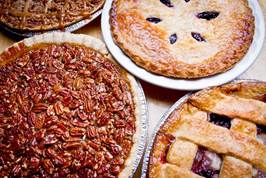
I love you all!

Start the 52-Week Savings Challenge Using Fibonacci Ideas

And, maybe learn about the Fibonacci Sequence which has so many implications in life, mathematics, art, and plants. I loved this whole formula as a kid and passed on the love to my kiddo. It is a beautiful way to look at the organization of life itself.

Your savings plan won’t be quite as sophisticated as this sequence but it’s an idea just to think about saving some more. I love this idea and hope you’ll try it! FYI:
The Fibonacci sequence is the series of numbers where each number is the sum of the two preceding numbers. For example, 0, 1, 1, 2, 3, 5, 8, 13, 21, 34, 55, 89, 144, 233, 377, 610, …

https://www.imaginationstationtoledo.org/about/blog/the-fibonacci-sequence

The following is from an email sent by my bank:
Start the 52-Week Savings Challenge!
Happy New Year! Ready to kick off 2025 with a fun and achievable financial goal? Start the 52-Week Savings Challenge! Each week, deposit an amount that matches the week of the year—$1 in week 1, $2 in week 2, $3 in week 3, and so on for 52 weeks! By the end of the year, you’ll have saved $1,378.00! For those that are math challenged:

Week / AmountWeek / Amount
127
228
329
430
531
632
733
834
935
1036
1137
1238
1339
1440
1541
1642
1743
1844
1945
2046
2147
2248
2349
2450
2551
2652
1378

It’s the perfect way to build your savings step by step and make 2025 your most financially rewarding year yet.

Here are some tips to make it even simpler:
💡 Automate weekly transfers.
🎯 Save for a specific goal.
📈 Use a tracker to stay motivated.
Ready to take on the challenge? Your future self will thank you!

And, you might have enough money to do something fun by the end of the year. Good luck and I’d love to hear how it works for you. Love and big hugs to all.

LIFE IS AN EDUCATION-Reflections from School in the 1960s-Wonders of Math-Part III

Memories of my junior high years were of math and socialization in the dating scene. Although I was not allowed to date until high school, I rationalized to myself that it was a silly ritual and why couldn’t we all just be friends and work together for the common goals – learning and changing the world! Madame Curie was my hero back then. The search for the perfect method interested me more than boys. I wouldn’t discover what that was all about until my senior year.

The earliest memories I have of classroom experiences in math and science were in my primary years. We used a lot of what’s now called math manipulatives in first through third grade, but students called them building blocks, straws, puzzles, and other manipulatives. I knew that I enjoyed math, but I hadn’t made any connections to the real-world problems. I still wasn’t sure what it was all about and why we had to do it. My first through third grade teachers always said that I performed well in all subjects, according to my old report cards. I have little recollection of junior high other than the girlfriend’s discovering boys before I did, and band practice. What was studied during this time was a mystery. You blank out your puberty years because you don’t want to remember them.

Magically, I would soon discover the wonders of Algebra, around seventh grade that put me in love with math and the problem-solving adventures once again! I would go inside my head and forget about the torture of the boy scene. I also loved language and took two years of French. Foreign languages came easy for me. I had a great teacher who took a trip to France one summer and brought back gifts for her favorite students. She also turned us on to pen pals and I corresponded with a French girl my age for years.

Algebra, Geometry, Trigonometry, and even some pre-Calculus classes were the new world that I discovered, and they were like translating a foreign language. We had a trigonometry teacher who had worked on the Manhattan Project in her college years! I continued to enjoy mathematics until my senior year. By that time, my test anxiety had increased tremendously over the high school years, and this anxiety was reflected the most in this advanced math class. During this time, we students were also given lots of achievement tests. Reflecting on this, this was the first look for these teachers at some sort of standardized testing. America was realizing that they needed smarter students and standards for graduation. I never did very well on those tests. No preparation was ever given before these tests. We just had to get out of class and go take the test. I usually felt like a failure after this class. There was too much emphasis on standardized testing (because of lots and lots of money to be made by contractors). It has some benefits for the teachers, and the students get desensitized to these types of tests with proper preparation time and pre-testing.

It’s always hindsight that lets us know where our system has failed us. Although I still believe in the ideal of a balanced education, math and science must eventually be considered as equals in this education process, not greater or lesser. Businesses today are recognizing the importance of science and math education for their future employees. As a result, charter and magnate schools are cropping up everywhere with their sponsorship leaving behind public schools in terms of assistance and funding.

Overall, I lacked the problem-solving skills for the higher sciences and math. Even though I had excellent drill and practice skills, could remember lots of facts, got A’s in all the labs, and intuit lots of answers, I couldn’t get the “part in the middle” or how to show my work, except in my science classes. Those were pure poetry for me. Completing science projects and using the scientific method gave me a sense of accomplishment! I loved to journal, so this was a natural expansion of journaling.

Upon reflection, I feel that’s why I elected to major in psychology, then went on to law enforcement, and finally, crime analysis. I liked having some knowns and rules of the game, but I also liked the challenge of figuring out all the unknowns. Solving crimes, profiling criminals’ behavior, looking at patterns, as well as delinquency issues were puzzles that were exciting and challenging to me. It also gave directions to officers as to what to do with these guys, giving them an understanding that just locking up someone doesn’t always work. I had to prove my work through studies from the real people I constantly worked with. I was able to produce reports that validated my theories of behaviors and crime patterns, thus making predictions for future trends.

For me, this never appeared to be a math and science exercise, but a human nature puzzle. It was exciting work. It was wonderful to create something new or at least new at the time, and work with the experts in the field. Yet even though I was doing real world mathematics and scientific studies, I still had that feeling that I didn’t know it.

Perhaps, if I had been given the opportunity to learn about math and science in the way of the new methods teachers utilize today, I would feel more confident in my abilities. I would naturally assume that the classroom learning relates to the real-world experience. Perhaps today I would just assume the process was not an abstract concept. People do all kinds of math and science every day, in their jobs, in their work at home, and they do this mentally. Women just don’t believe it is math and science.

Perhaps if teachers in our day had approached subject matter as an inter-disciplinary approach, for all students, male or female, we would understand and enjoy all the subjects, even social studies. We would understand that there is math and science in every subject. There are many literature books that include math as part of the subject, woven into a beautiful story. It is as much as part of our lives as the liberal arts are. We don’t need to swing radically to absorbing only math-related subjects. And we should not swing radically in the other direction that excludes math-related information. Reading and literature must blend with math and science to create a so-called well-rounded education.

What I have learned in my experiences is that some teachers are excellent blenders of theory and hands on experiences. Some just know the drills. All front-line educators should be given the resources and time opportunities to combine fact learning with experiential learning. Students should work individually on projects and explore and expand the limits of individual thinking. Admittedly, cooperation is important in today’s societal norms and job market. Group activities can and should be successful learning experiences for all students. Not all students are strong in a group. Some are perfectly content to let others do the work, and we all know that a strong leader always emerges. There needs to be accountability in the group settings so that every individual participates and learns the lesson being taught. Individual creativity is crucial to individual growth, and individual growth leads to new discoveries and the development of new ways of thinking and doing.

Stay tuned for Part IV tomorrow-the final installation of this story!

Love and hugs to everyone who reads this blog and makes a small difference each day they live!

Note: Parts of this post were originally written for a graduate level class in the late 1990s. Some teaching methods have improved over the last two decades. I would love to hear teachers respond to this blog, how they help students learn, and what the new methods are to teach in an integrative learning environment. Thanks to all teachers who are dedicated to the craft in these trying times!